

Puglia has experienced Italy's fastest tourism growth over the past twenty years. Credit goes partly to Alberobello's trulli, partly to Lecce's baroque architecture, partly to Salento's beaches, but mostly to a landscape unlike anywhere else in Italy: flat, luminous, white with limestone, fragrant with olive groves.

Puglia's villages have strikingly different characters. Alberobello is a UNESCO site with cone-roofed stone houses found nowhere else on earth. Lecce is a baroque city built entirely from local stone that carves like wood and turns golden at sunset. Ostuni is a white city perched on three hills overlooking the sea. Polignano a Mare is a medieval village clinging to cliffs above the Adriatic.
Alberobello and the Itria Valley

Alberobello is Puglia's most recognisable village worldwide. The trulli, limestone dwellings with conical roofs built without mortar, became a UNESCO World Heritage site in 1996. Their practical origin was fiscal: built without lime, they could be dismantled quickly to avoid taxes on permanent settlements.
The historic centre divides into two quarters: Monti, containing over a thousand trulli, and Aia Piccola, quieter and more authentic. The Trullo Sovrano is the only two-storey example, topped with a fourteen-metre dome. The Church of Sant'Antonio da Padova is itself a trullo shaped as a Greek cross.

The Itria Valley around Alberobello holds other villages worth visiting: Locorotondo with its white houses arranged in circles on the hillside, Cisternino with butcher shops where you eat grilled meat directly from the counter, Martina Franca with its baroque historic centre.
Ostuni: the white city

Ostuni rises on three hills eighteen kilometres from the sea. White houses, whitewashed annually in a centuries-old tradition, form a maze of alleyways and staircases visible from dozens of kilometres away. The Cathedral of Santa Maria Assunta, with its Gothic-Renaissance facade, dominates the village's highest point.
Ostuni is also a seaside destination: the coast below has white sandy beaches and crystal waters, including Torre Guaceto, a protected marine and terrestrial area.
Lecce: the Florence of the South

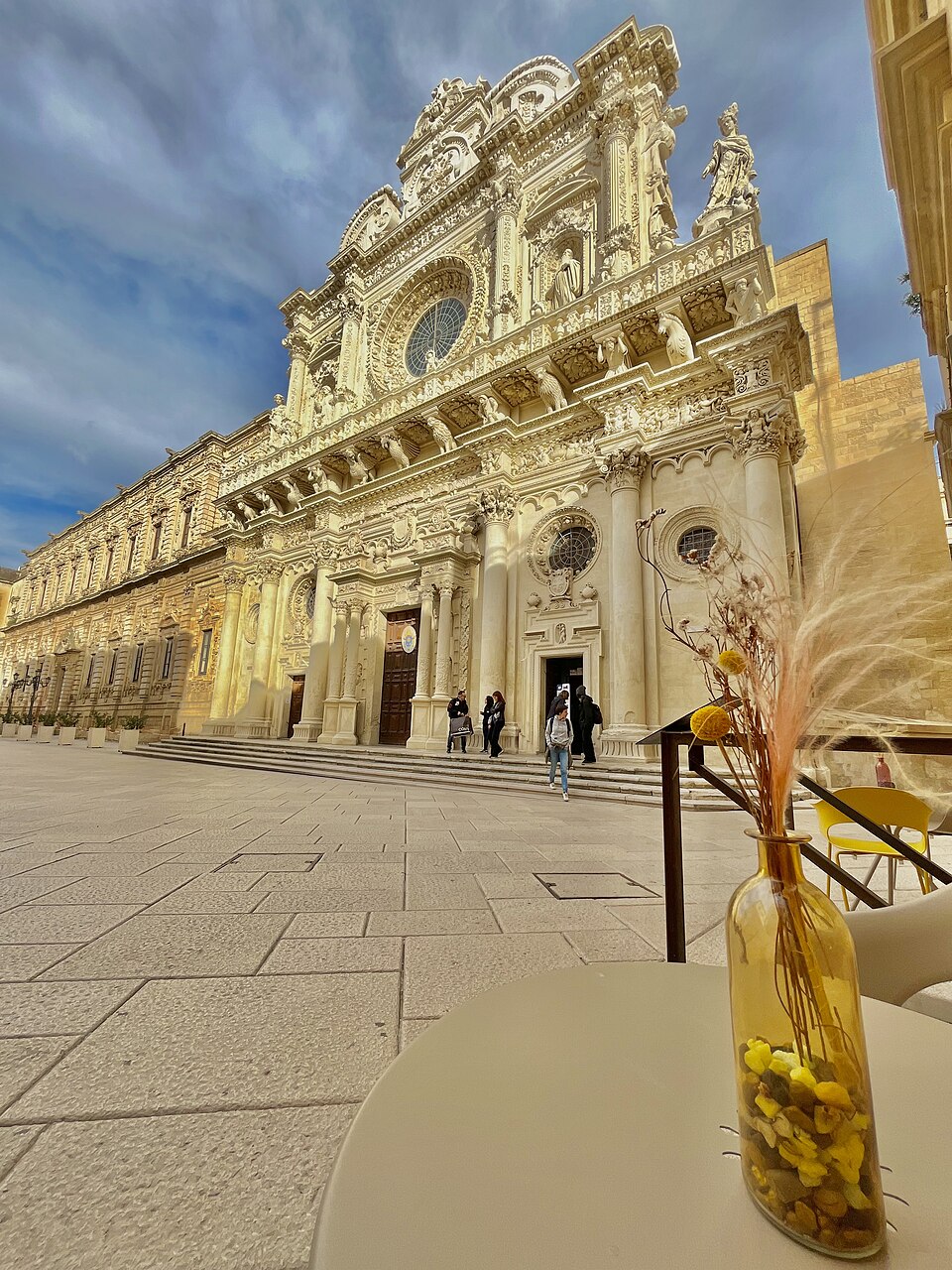
Lecce is built entirely from lecce stone, a soft honey-coloured limestone carved with chisel precision impossible with other materials. The result is a baroque city of extraordinary decorative richness: facades adorned with cherubs, garlands, scrolls, cartouches, fantastical creatures.
The Basilica of Santa Croce is Lecce's symbolic monument: its facade is a complete catalogue of lecce baroque, with roses, griffins, sphinxes and foliage carved through a millennium of craftsman tradition. Piazza del Duomo, enclosed on three sides, has an intimate, almost theatrical atmosphere.
Lecce also contains a Roman amphitheatre from the 2nd century AD in the main square, discovered by chance in the twentieth century during construction work and now open to visitors.
Polignano a Mare

Polignano a Mare is a medieval village in Bari province built on limestone cliffs dropping straight into the Adriatic. Historic centre houses overlook the sea directly, and marine caves beneath the village are reachable by boat. Lama Monachile Beach, nestled between two white rock walls, ranks among Puglia's most photographed beaches.
Polignano is the birthplace of Domenico Modugno, an artist famous for songs known worldwide. A statue on the waterfront shows him with arms outstretched, as in the song that made him world-famous.
Otranto and the Salento

Otranto sits at Puglia's far south-eastern tip, on the Salento's Adriatic coast. The Aragonese Castle and Cathedral are the main monuments. The cathedral features an 11th-century mosaic floor created by a monk who depicted the entire history of the world in mosaic: 600 square metres of biblical, historical and mythological scenes.
Otranto is also mainland Italy's easternmost point. Ferries to Greece depart from its port.

The Salento, the peninsula between two seas, contains villages like Gallipoli (historic centre on an island in the Ionian Sea with Aragonese walls), Nardò with its baroque square, and Specchia, a small medieval village in Salento's heart.
Northern Puglia: Trani and Castel del Monte

Trani is northern Puglia's city worth the journey. The Cathedral of San Nicola Pellegrino rises directly from the sea, built in white limestone on a platform overlooking the Adriatic. It ranks among Puglia's Romanesque masterpieces and among the world's rare cathedrals built with feet nearly in water. The port, with its Art Nouveau palaces and fishing boats, draws locals in the evening.

Castel del Monte, inland in Barletta-Andria-Trani province, is an octagonal 13th-century castle built by Frederick II of Swabia on an isolated hill. Its perfect geometry, the number eight governing every proportion, its marbles and local stone make this building an architectural enigma scholars still debate. It became a UNESCO site in 1996 and appears on Italian one-cent euro coins.
The Dauni Hills: unexpected Puglia
Inland in the Foggia region, bordering Campania and Molise, the Dauni Hills represent one of Puglia's most authentic and least-visited territories. Six villages here hold the Touring Club's Orange Flag award; no other area in southern Italy has such concentration. Almost nobody knows them, which is precisely why you should go.

Bovino is the best-known Dauni village, ranking among Italy's most beautiful villages. The historic centre spreads across two hills with the ducal castle, cathedral and a maze of stone alleyways. A few kilometres away sits Troia, featuring a 12th-century Romanesque cathedral and a pierced rose window considered one of medieval Puglian architecture's masterpieces, virtually unknown to tourists.
Pietramontecorvino is dominated by a Norman tower and ducal palace, reached through a Gothic arch introducing the Terra Vecchia, the village's oldest nucleus.
Alberona is the smallest and most isolated: a Templar church, fountains, a viewpoint over Puglia's Tavoliere plain. Fewer than a thousand people live here.
Roseto Valfortore has restored water mills, stonemasons still working stone, and a natural pool in the stream. Autumn brings a black truffle festival.
Orsara di Puglia has a medieval centre with a 12th-century San Michele rupestral grotto and a gastronomic reputation far exceeding the village's size.
Dauni Hills cuisine belongs to the Apennine interior: podolica caciocavallo cheese, lamb, black truffle, Nero di Troia wine. No seafood, no organised tourism, no fashionable destination prices.
Puglian cuisine

Puglia produces forty percent of Italy's olive oil. Orecchiette with turnip greens, Andria burrata cheese, taralli crackers, Bari focaccia and Cisternino bombette (grilled meat rolls) are must-try dishes. Primitivo di Manduria wine and Negroamaro rank among southern Italy's most appreciated reds.
Practical information
Getting there. Main airports are Bari (Karol Wojtyla) and Brindisi. Both have direct flights from many European cities. Brindisi is more convenient for Salento and Lecce.
When to go. May, June and September are ideal: perfect weather, accessible beaches, fewer crowds. July and August see heavy traffic on Salento's coasts. Interior villages like Alberobello and Lecce work well year-round.
Visit Alberobello's Rione Monti early morning, before tour groups arrive. Cisternino: Saturday evenings see grilled meat eaten in butcher shops downtown. Lecce: sunset light on the Basilica of Santa Croce is the day's most beautiful moment. Otranto: view the cathedral floor in natural light, arrive before 11am.