Choose your stay and contact the host directly to get a better deal than on the big booking sites.Browse stays →
Emilia-Romagna · Villages
Emilia-Romagna Complete Guide: Bologna, Ravenna, Ferrara and the Via Emilia
08 giugno 2026·4 min di lettura
Emilia-Romagna consists of two historically distinct regions united into one. Emilia, with the Via Emilia as its backbone, stretches from Piacenza to Bologna through Parma, Reggio Emilia and Modena. Romagna, encompassing Ravenna, Forlì, Cesena and Rimini, faces the Adriatic coast. The character of each differs markedly: Emilia is more urban, bourgeois, and gastronomically focused; Romagna is more popular, festive, and beach-oriented. This guide concentrates on the first, the historic region of Emilia.
Together they form Italy's richest culinary region. Parmigiano Reggiano, Prosciutto di Parma, Prosciutto di Modena, Aceto Balsamico Tradizionale from Modena and Reggio Emilia, Bologna mortadella, tortellini, tagliatelle al ragù: all originate from this strip of Po Valley plain between the Apennines and the Po River.
Bologna is Emilia-Romagna's most vibrant city and among Italy's most beautiful. The historic centre features arcaded streets totalling forty-four kilometres in length, making the city entirely walkable even during rain. Bologna's porticoes earned UNESCO World Heritage status in 2021.
Piazza Maggiore, dominated by the Basilica of San Petronio and the Palazzo del Podestà, forms the city's heart. Giambologna's Fountain of Neptune, completed in 1566, stands as one of Bologna's most recognisable monuments.
The Two Towers, Asinelli and Garisenda, represent the city's medieval identity. The Torre degli Asinelli, standing 97 metres tall, is open to visitors: 498 steps lead to panoramic views across the Po plain with the Alps on the horizon.
The University of Bologna, founded in 1088, remains the oldest continuously operating university in the Western world. Tens of thousands of students create a nightlife and cultural scene that few Italian cities of comparable size can match.
Ravenna served as capital for three great civilisations: the Western Roman Empire, the Ostrogothic kingdom of Theodoric, and the Byzantine Exarchate. Each era left behind mosaics now designated UNESCO World Heritage sites.
Ravenna's mosaics, created between the fifth and sixth centuries, represent the world's finest in quality, quantity and preservation. The Mausoleum of Galla Placidia, with its golden stars against a blue vault, is the oldest and most moving. The octagonal Basilica of San Vitale contains mosaics depicting Emperor Justinian and Empress Theodora with their courts in an unparalleled solemnity within medieval art.
Ravenna is also where Dante Alighieri spent his final years and where he is buried. Dante's tomb occupies a small chapel in the city centre.
Ferrara exemplifies planned Renaissance urbanism: its streets are wider, perspectives longer, geometry more evident than in organic medieval towns. The Este family, one of the Italian Renaissance's most influential ruling dynasties, transformed the city into a centre of art and culture during the fifteenth and sixteenth centuries.
The Castello Estense, surrounded by its moat, anchors the city centre; visitors still enter Ferrara by car crossing the drawbridges. Palazzo Schifanoia displays extraordinary fifteenth-century frescoes depicting the months' cycle with court life scenes. The Cathedral combines a Romanesque facade with Gothic portals.
Ferrara's historic centre and the Po Delta have been UNESCO World Heritage sites since 1995. The Po Delta, just kilometres from the city, ranks among Italy's most distinctive natural landscapes: a labyrinth of canals, fishing valleys, lagoons and islands accessible by boat or bicycle.
Modena enjoys worldwide fame for three things: Ferrari and Maserati (born in the surrounding area), Luciano Pavarotti (born here in 1935) and Aceto Balsamico Tradizionale. The Romanesque Cathedral, the Ghirlandina Tower and Piazza Grande earned UNESCO status in 1997.
Aceto Balsamico Tradizionale di Modena DOP ages for a minimum of twelve years in progressively smaller wooden barrels. Vinegar aged twenty-five years or longer costs hundreds of euros per hundred millilitres. Acetaia producers welcome visits by appointment.
The Motor Valley, spanning the area between Modena and Maranello, contains museums dedicated to Ferrari, Maserati, Lamborghini, Ducati and De Tomaso. The Maranello Ferrari Museum opens year-round.
Parma's gastronomic reputation rivals few European cities: Prosciutto di Parma DOP, Parmigiano Reggiano DOP and Culatello di Zibello DOP rank among the world's most imitated and most protected products.
The historic centre contains a Romanesque Cathedral with a dome frescoed by Correggio in the sixteenth century, an octagonal Baptistry in pink Verona marble from the twelfth to thirteenth centuries, and the Farnese Theatre of 1618, one of Italy's most important Baroque theatres.
Nearby ham factories and cheese dairies welcome visitors: watching forty-kilogramme wheels of Parmigiano Reggiano being hand-turned in milk vats creates a memory that lingers.
Castell'Arquato and Apennine Villages
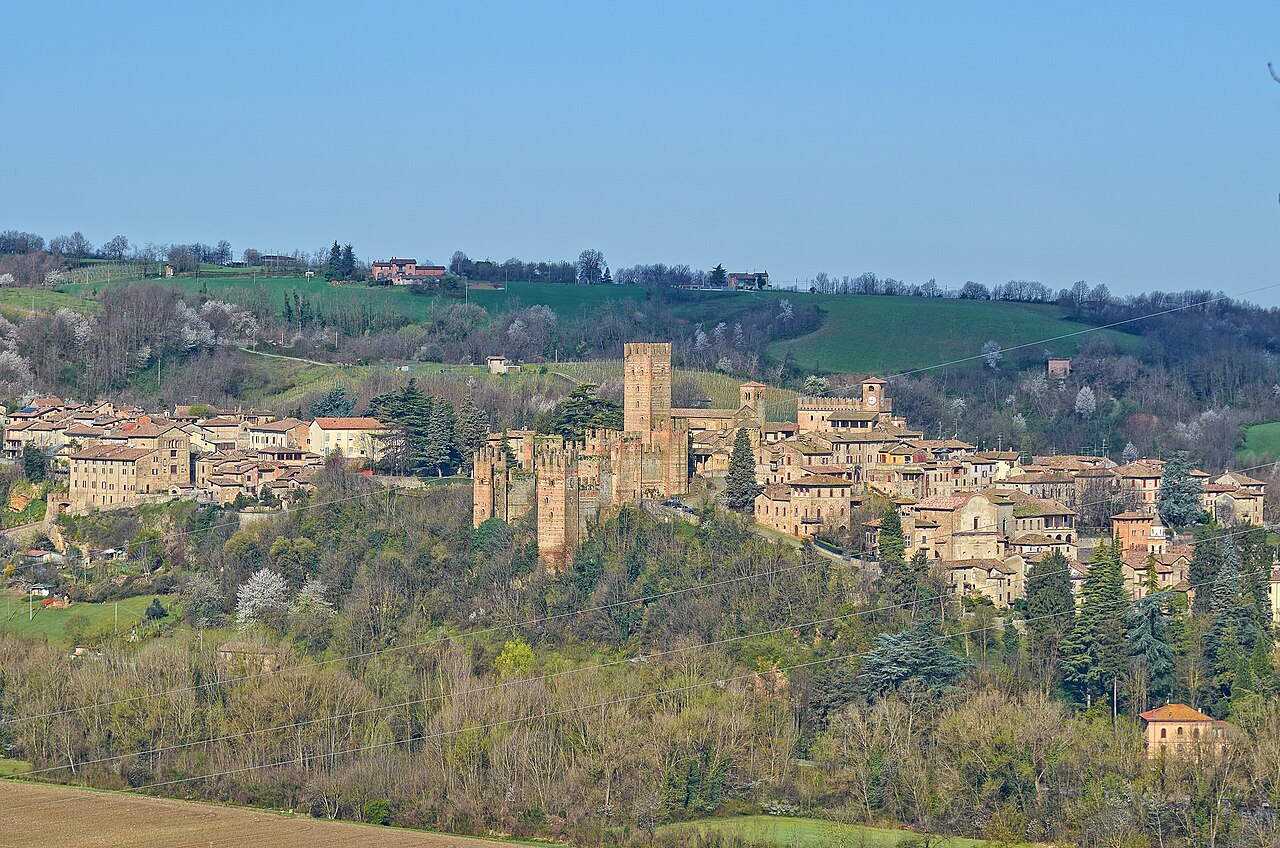
In the Piacenza Apennines, Castell'Arquato ranks among Emilia-Romagna's finest medieval villages, featuring a fourteenth-century Rocca, a Romanesque Collegiate Church and a piazza with views across the hills. It serves as a gateway to exploring the Colli Piacentini wine region, known for Gutturnio and Ortrugo wines.
Brisighella, in Romagna, perches on three hills with a medieval tower, a fortress and the Via degli Asini, a covered elevated passageway crossing the historic centre.
Practical Information
How to arrive: Bologna airport serves as the region's primary hub, with direct flights from many European cities. High-speed trains traverse the Via Emilia, connecting all major towns.
When to visit: Art cities are rewarding year-round. Spring and autumn suit Apennine villages best. The Po Delta proves spectacular in autumn during bird migrations.
Top tips: In Ravenna, purchase a combined ticket for all UNESCO sites; it costs significantly less than individual entries. In Modena, book acetaia visits well ahead as some operate by appointment only. Climb Bologna's Torre degli Asinelli early morning for optimal light. Cheese dairies in Parma begin Parmigiano production early; verify opening times before visiting.